Measurement of Muon Neutrino Induced Charged Current Interactions Without Charged Pions in the Final State Using a New T2K Off-Axis Near Detector WAGASCI-BabyMIND
We report a flux-integrated cross section measurement of muon neutrino interactions on water and hydrocarbon via charged current reactions without charged pions in the final state with the WAGASCI-BabyMIND detector, which was installed in the T2K near detector hall in 2018. The detector is located 1.5° off-axis and is exposed to a more energetic neutrino flux than ND280, another T2K near detector, which is located at a different off-axis position. The total flux-integrated cross section is measured to be 1.26±0.18(stat+syst)×10−39 cm2/nucleon on CH and 1.44±0.21(stat+syst)×10−39 cm2/nucleon on H2O. These results are compared to model predictions provided by the neut v5.3.2 and genie v2.8.0 Monte Carlo generators and the measurements are compatible with these models. Differential cross sections in muon momentum and cosine of the muon scattering angle are also reported. This is the first such measurement reported with the WAGASCI-BabyMIND detector and utilizes the 2020 and 2021 datasets.
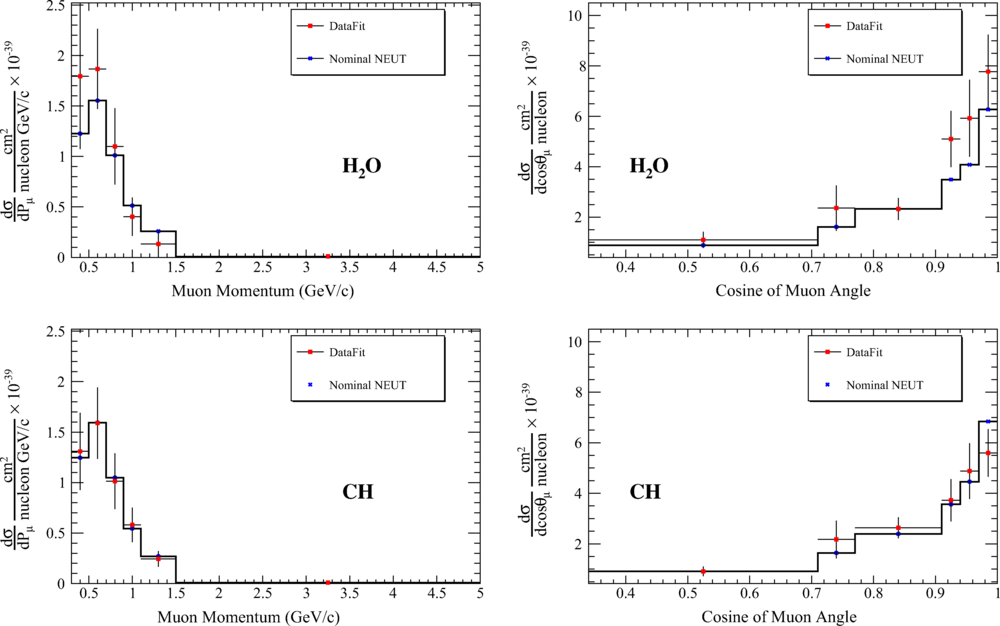
Differential cross section result. The plots on the top refer to the H2O target and the ones on the bottom to the CH target.
Results from the T2K Experiment on Neutrino Mixing Including a New Far Detector Muon-like Sample
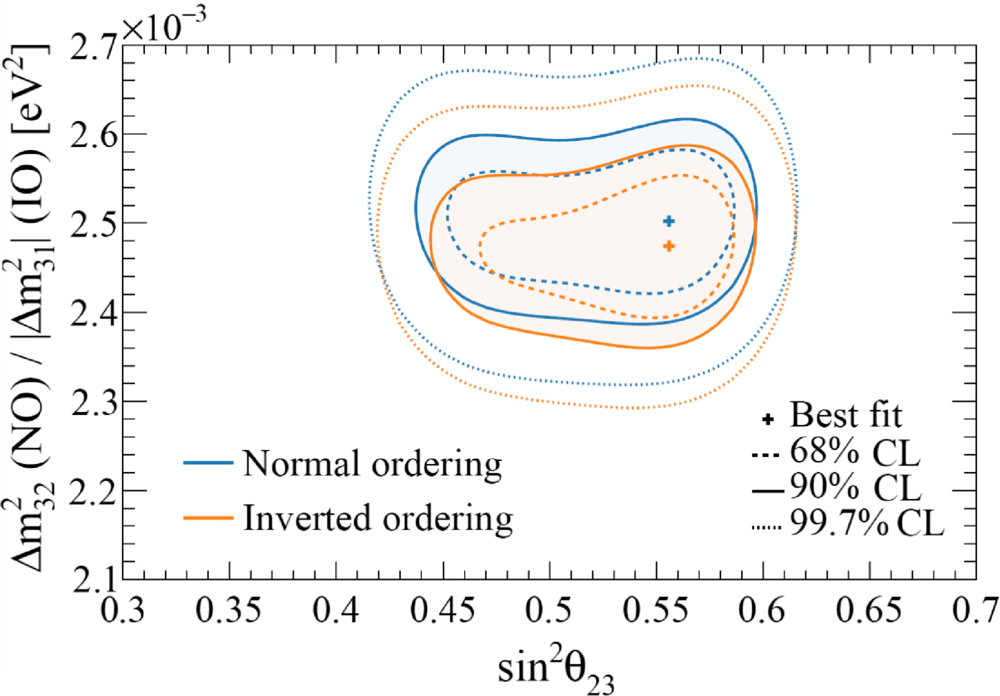
We have made improved measurements of three-flavor neutrino mixing with 19.7(16.3) × 1020 protons on target in (anti-)neutrino-enhanced beam modes. A new sample of muon-neutrino events with tagged pions has been added at the far detector, as well as new proton and photon-tagged samples at the near detector. Significant improvements have been made to the flux and neutrino interaction modeling. T2K data continue to prefer the normal mass ordering and upper octant of sin2𝜃23 with a near-maximal value of the charge-parity violating phase with best-fit values in the normal ordering of 𝛿CP=−2.18+1.22−0.47, sin2𝜃23=0.559+0.018−0.078 and Δ𝑚232=(+2.506+0.039−0.052)×10−3 eV2.
Testing T2K’s Bayesian constraints with priors in alternate parameterisations
Bayesian analysis results require a choice of prior distribution. In long-baseline neutrino oscillation physics, the usual parameterisation of the mixing matrix induces a prior that privileges certain neutrino mass and flavour state symmetries. Here we study the effect of privileging alternate symmetries on the results of the T2K experiment. We find that constraints on the level of CP violation (as given by the Jarlskog invariant) are robust under the choices of prior considered in the analysis. On the other hand, the degree of octant preference for the atmospheric angle depends on which symmetry has been privileged.
Joint neutrino oscillation analysis from the T2K and NOvA experiments
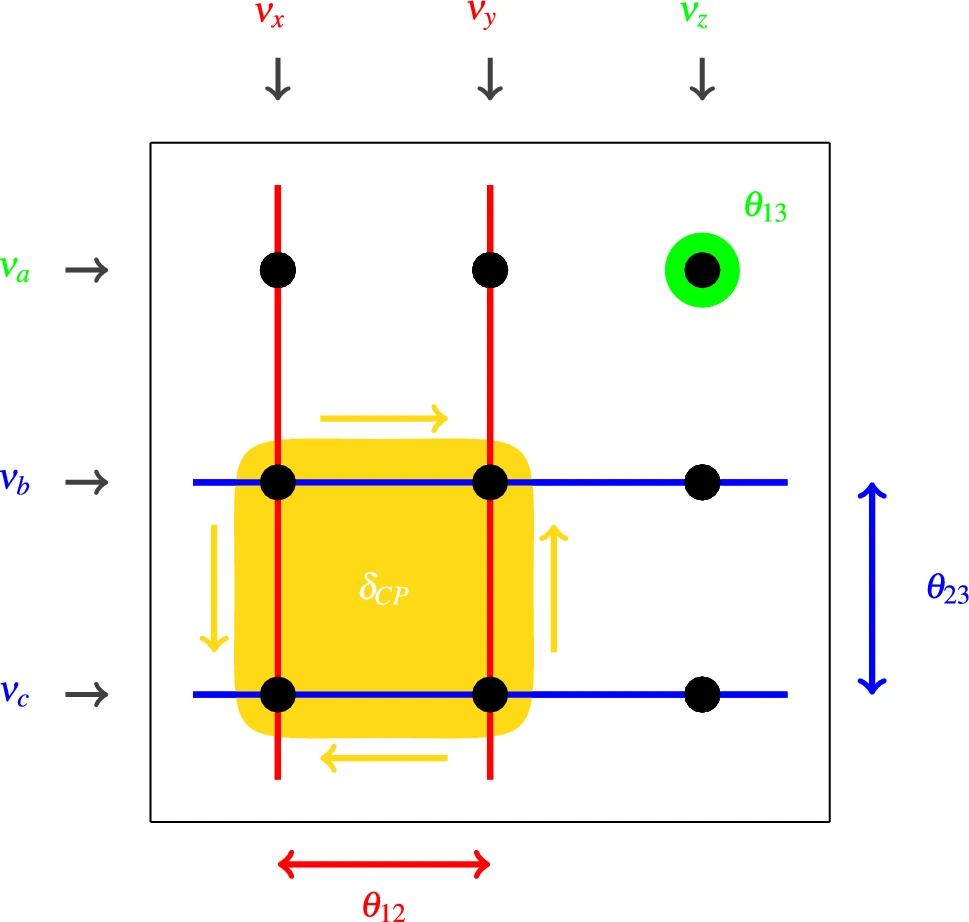
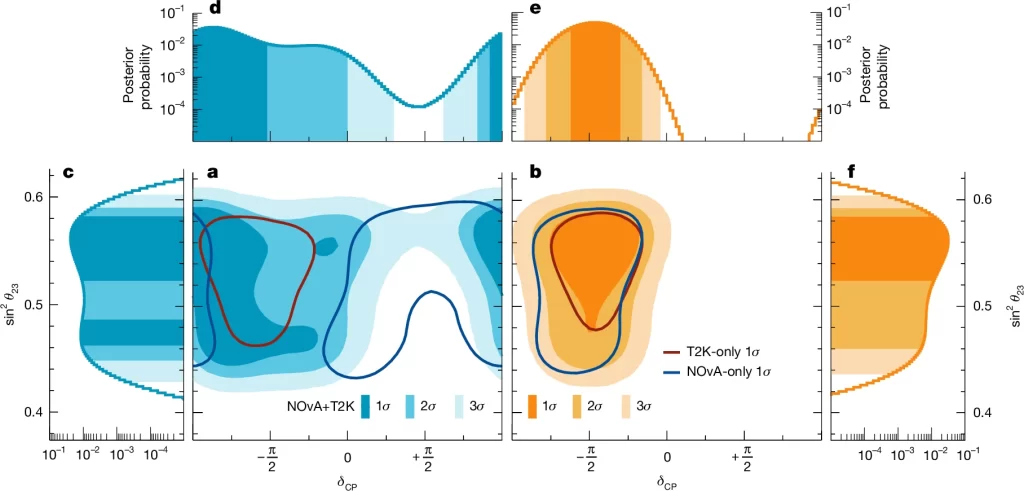
The landmark discovery that neutrinos have mass and can change type (or flavour) as they propagate—a process called neutrino oscillation—has opened up a rich array of theoretical and experimental questions being actively pursued today. Neutrino oscillation remains the most powerful experimental tool for addressing many of these questions, including whether neutrinos violate charge-parity (CP) symmetry, which has possible connections to the unexplained preponderance of matter over antimatter in the Universe. Oscillation measurements also probe the mass-squared differences between the different neutrino mass states Δm2, whether there are two light states and a heavier one (normal ordering) or vice versa (inverted ordering), and the structure of neutrino mass and flavour mixing. Here we carry out the first joint analysis of datasets from NOvA and T2K, the two currently operating long-baseline neutrino oscillation experiments (hundreds of kilometres of neutrino travel distance), taking advantage of our complementary experimental designs and setting new constraints on several neutrino sector parameters. This analysis provides new precision on the Δm2 mass difference, finding 2.43+0.04−0.03 × 10⁻³ eV2 in the normal ordering and −2.48++0.03−0.04 × 10⁻³ eV2 in the inverted ordering, as well as a 3σ interval on δCP of [−1.38π, 0.30π] in the normal ordering and [−0.92π, −0.04π] in the inverted ordering. The data show no strong preference for either mass ordering, but notably, if inverted ordering were assumed true within the three-flavour mixing model, then our results would provide evidence of CP symmetry violation in the lepton sector.
First Measurement of the Electron-Neutrino Charged-Current Pion Production Cross Section on Carbon with the T2K Near Detector
The T2K Collaboration presents the first measurement of electron neutrino-induced charged-current pion production on a predominantly carbon target in a restricted kinematical phase space. This is performed using data from the 2.5° off-axis near detector, ND280. The differential cross sections with respect to the outgoing electron and pion kinematics, in addition to the total flux-integrated cross section, are obtained. Comparisons between the measured and predicted cross-section results using the neut, genie, and nuwro Monte Carlo event generators are presented. The measured total flux-integrated cross section is [2.52±0.52(stat)±0.30(syst)]×10−39 cm2 nucleon−1, which is lower than the event generator predictions.
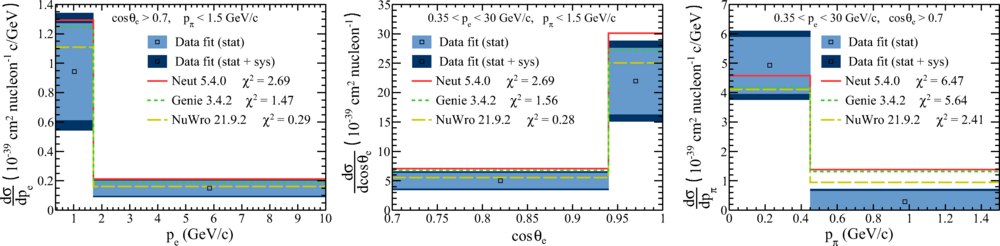
The differential flux-integrated cross-section results and predictions from neut, genie, and nuwro as a function of particle kinematics.
First measurement of neutron capture multiplicity in neutrino-oxygen neutral-current quasielasticlike interactions using an accelerator neutrino beam
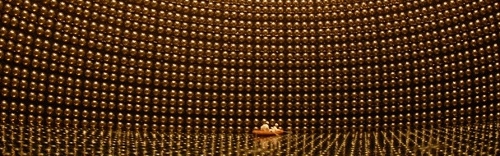
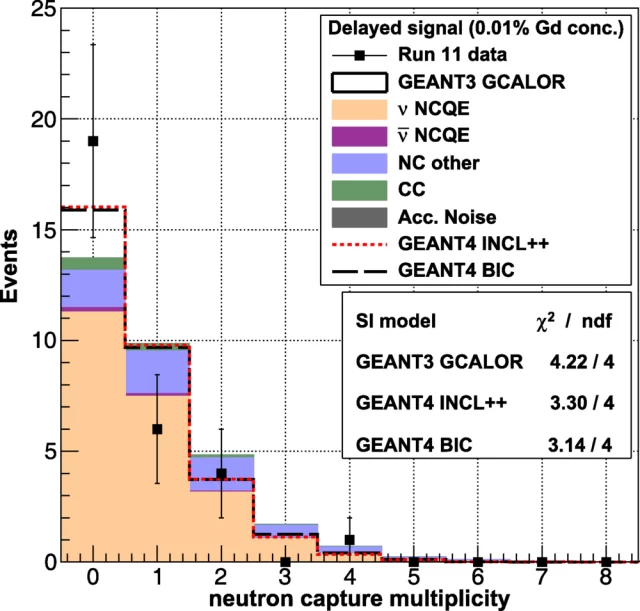
This paper reports the first measurement of neutron capture multiplicity in neutrino-oxygen neutral-current quasielasticlike interactions at the gadolinium-loaded Super-Kamiokande detector using the T2K neutrino beam, which has a peak energy of about 0.6 GeV. A total of 30 neutral-current quasielasticlike event candidates were selected from T2K data corresponding to an exposure of 1.76 ×10²⁰ protons on target. The 𝛾 ray signals resulting from neutron captures were identified using a neural network. The flux-averaged mean neutron capture multiplicity was measured to be 1.37±0.33 (stat.)+0.17−0.27 (syst.), which is compatible within 2.3 sigma than predictions obtained using our nominal simulation. We discuss potential sources of systematic uncertainty in the prediction and demonstrate that a significant portion of this discrepancy arises from the modeling of hadron-nucleus interactions in the detector medium.
First measurement of muon neutrino charged-current interactions on hydrocarbon without pions in the final state using multiple detectors with correlated energy spectra at T2K
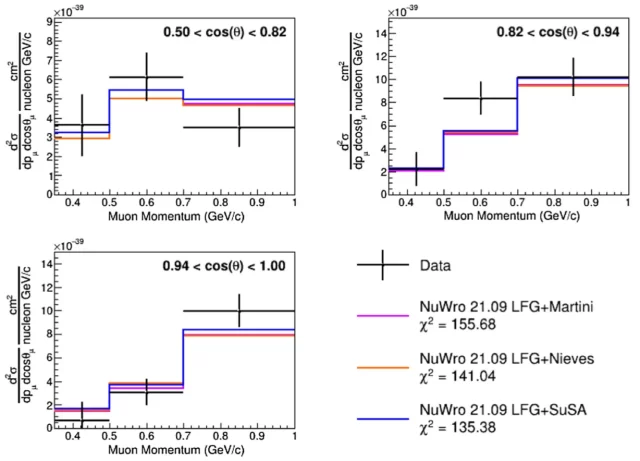
This paper reports the first measurement of muon neutrino charged-current interactions without pions in the final state using multiple detectors with correlated energy spectra at T2K. The data was collected on hydrocarbon targets using the off-axis T2K near detector (ND280) and the on-axis T2K near detector (INGRID) with neutrino energy spectra peaked at 0.6 GeV and 1.1 GeV, respectively. The correlated neutrino flux presents an opportunity to reduce the impact of the flux uncertainty and to study the energy dependence of neutrino interactions. The extracted double-differential cross sections are compared to several Monte Carlo neutrino-nucleus interaction event generators showing the agreement between both detectors individually and with the correlated result.
Measurements of the muon-neutrino and muon-antineutrino-induced coherent charged pion production cross sections on carbon-12 by the T2K experiment.
This paper reports the T2K measured muon-neutrino and muon-antineutrino-induced charged current coherent pion production flux-averaged cross section on carbon-12 within a restricted kinematic phase-space. The results are compatible with both the NEUT 5.4.0 Berger-Sehgal (2009) and GENIE 2.8.0 Rein-Sehgal (2007) model predictions.
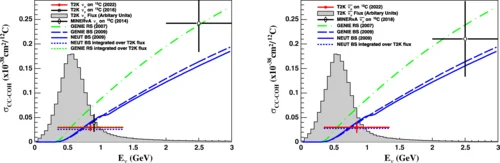
The T2K muon-neutrino (left) and muon-antineutrino (right) CC-COH cross section measurement on C assuming F(A) = A^(1/3).
First joint oscillation analysis of Super-Kamiokande atmospheric and T2K accelerator neutrino data
The Super-Kamiokande and T2K collaborations present a joint measurement of neutrino oscillation parameters from their atmospheric and beam neutrino data. A common neutrino interaction model has been developed for the events of the two experiments which overlap in energy, and correlations between their detector systematic uncertainties were evaluated. Using 3244.4 days of atmospheric data and a beam exposure of respectively 19.7E20 and 16.3E20 protons on target in neutrino and antineutrino running modes, we find an exclusion of the CP-conserving value of the Jarlskog invariant with a significance varying between 1.9σ and 2.0σ depending on the analysis considered, a limited preference for the normal mass ordering (MO), and no strong preference for the θ23 octant.
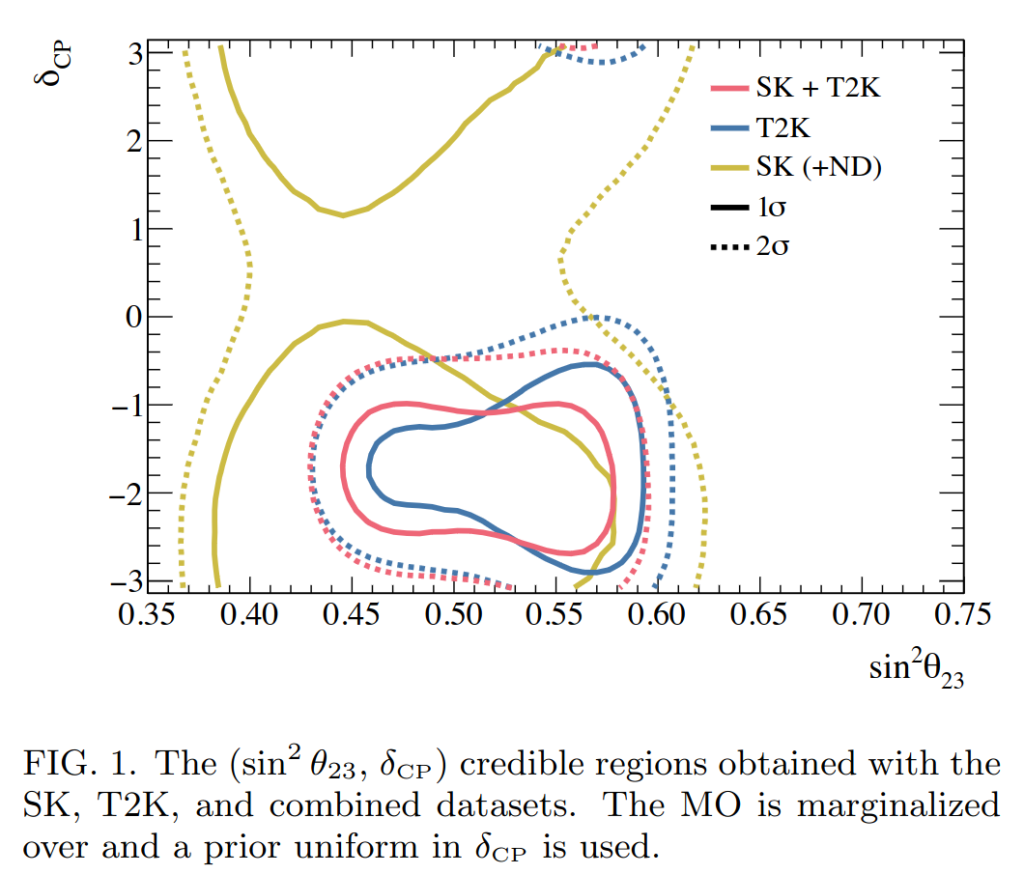
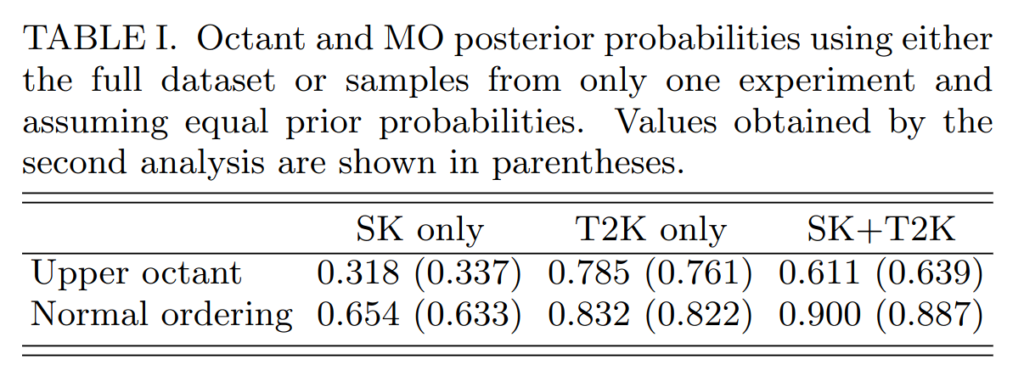
arXiv preprint : https://arxiv.org/pdf/2405.12488
Updated T2K measurements of muon neutrino and antineutrino disappearance using 3.6E21 protons on target
https://arxiv.org/abs/2305.09916Muon neutrino and antineutrino disappearance probabilities are identical in the standard three-flavor neutrino oscillation framework, but CPT violation and non-standard interactions can violate this symmetry. In this work we report the measurements of sin2θ23 and Δm232 independently for neutrinos and antineutrinos. The aforementioned symmetry violation would manifest as an inconsistency in the neutrino and antineutrino oscillation parameters. The analysis discussed here uses a total of 1.97E21 and 1.63E21 protons on target taken with a neutrino and antineutrino beam respectively, and benefits from improved flux and cross-section models, new near detector samples and more than double the data reducing the overall uncertainty of the result. No significant deviation is observed, consistent with the standard neutrino oscillation picture.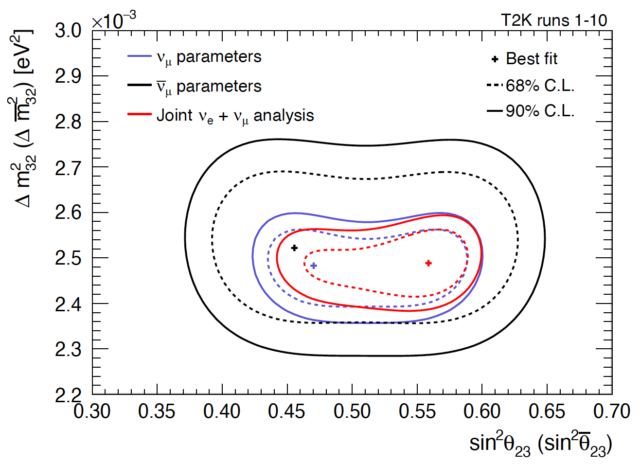
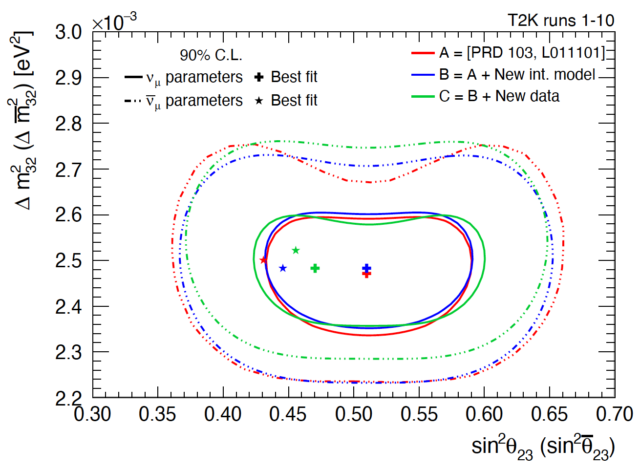
arXiv preprint : https://arxiv.org/pdf/2305.09916
Data release : https://zenodo.org/record/7929975