Measurement of the Inclusive Electron Neutrino Charged Current Cross Section on Carbon with the T2K Near Detector

The T2K off-axis near detector, ND280, is used to make the first differential cross-section measurements of electron neutrino charged current interactions at energies ∼1 GeV as a function of electron momentum, electron scattering angle and four-momentum transfer of the interaction. The total flux-averaged νe charged current cross-section on carbon is measured to be <σ>ϕ = 1.11±0.09(stat) ±0.18(syst)×10-38 cm2/nucleon.
The differential and total cross-section measurements agree with the predictions of two leading neutrino interaction generators, NEUT and GENIE. The NEUT prediction is 1.23×10-38 cm2/nucleon and the GENIE prediction is 1.08×10-38 cm2/nucleon. The total νe charged current cross-section result is also in agreement with data from the Gargamelle experiment.
Measurement of the neutrino-oxygen neutral-current interaction cross section by observing nuclear deexcitation γ rays
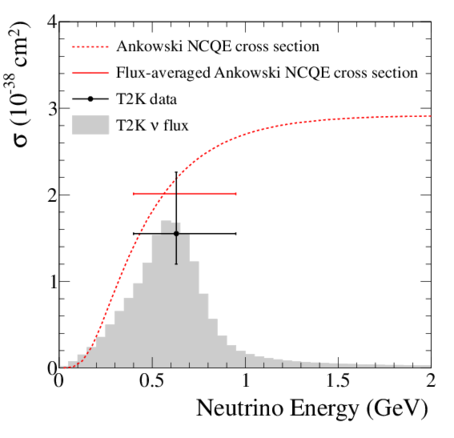
We report the first measurement of the neutrino-oxygen neutral-current quasielastic (NCQE) cross section. It is obtained by observing nuclear deexcitation γ-rays which follow neutrino-oxygen interactions at the Super-Kamiokande water Cherenkov detector. We use T2K data corresponding to 3.01 × 10²⁰ protons on target. By selecting only events during the T2K beam window and with well-reconstructed vertices in the fiducial volume, the large background rate from natural radioactivity is dramatically reduced. We observe 43 events in the 4-30 MeV reconstructed energy window, compared with an expectation of 51.0, which includes an estimated 16.2 background events. The background is primarily nonquasielastic neutral-current interactions and has only 1.2 events from natural radioactivity. The flux-averaged NCQE cross section we measure is 1.55 × 10-38 cm2 with a 68% confidence interval of (1.22, 2.20) × 10-38 cm2 at a median neutrino energy of 630 MeV, compared with the theoretical prediction of 2.01 × 10-38 cm2.
Measurement of the intrinsic electron neutrino component in the T2K neutrino beam with the ND280 detector
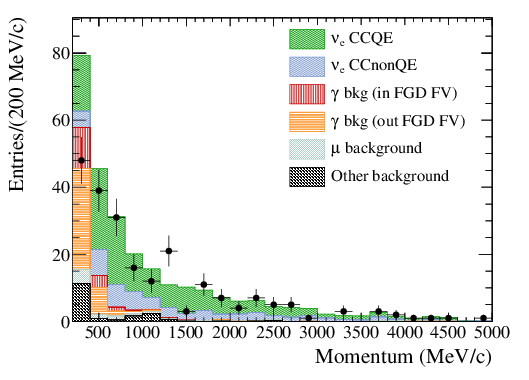
The main and irreducible background to the appearance signal comes from the presence in the neutrino beam of a small intrinsic component of electron neutrinos originating from muon and kaon decays. In T2K, this component is expected to represent 1.2% of the total neutrino flux. A measurement of this component using the near detector (ND280), located 280 m from the target, is presented. The charged current interactions of electron neutrinos are selected by combining the particle identification capabilities of both the time projection chambers and electromagnetic calorimeters of ND280. The measured ratio between the observed electron neutrino beam component and the prediction is 1.01±0.10 providing a direct confirmation of the neutrino fluxes and neutrino cross section modeling used for T2K neutrino oscillation analyses. Electron neutrinos coming from muons and kaons decay are also separately measured, resulting in a ratio with respect to the prediction of 0.68±0.30 and 1.10±0.14, respectively.
Precise Measurement of the Neutrino Mixing Parameter θ23 from Muon Neutrino Disappearance in an Off-axis Beam
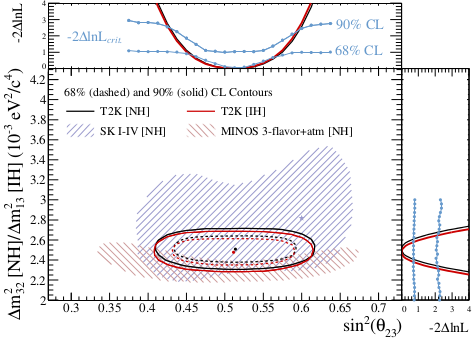
New data from the T2K neutrino oscillation experiment produce the most precise measurement of the neutrino mixing parameter θ23. Marginalizing over the values of other oscillation parameters yields sin2 (θ23) = 0.514 +0.055-0.056 (0.511 ± 0.055), assuming normal (inverted) mass hierarchy. The best-fit mass-squared splitting for normal hierarchy is Δm232 = 2.51 ± 0.10 × 10⁻³ eV2/c4 (inverted hierarchy: Δm213 = 2.48 ± 0.10 × 10⁻³ eV2/c4). Adding a model of multinucleon interactions that affect neutrino energy reconstruction is found to produce only small biases in neutrino oscillation parameter extraction at current levels of statistical uncertainty.
Observation of Electron Neutrino Appearance in a Muon Neutrino Beam
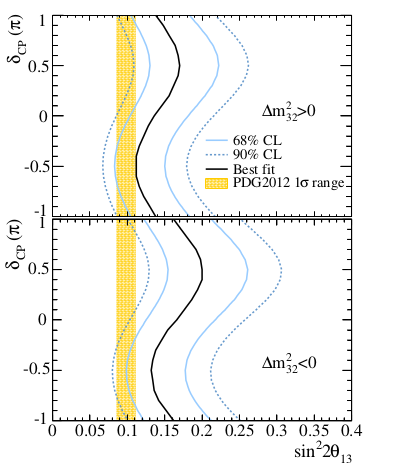
The T2K experiment has observed electron neutrino appearance in a muon neutrino beam produced 295 km from the Super-Kamiokande detector with a peak energy of 0.6 GeV. A total of 28 electron neutrino events were detected with an energy distribution consistent with an appearance signal, corresponding to a significance of 7.3σ when compared to 4.92 ± 0.55 expected background events. In the PMNS mixing model, the electron neutrino appearance signal depends on several parameters including three mixing angles θ12, θ23, θ13, a mass difference Δm232 and a CP violating phase δCP. In this neutrino oscillation scenario, assuming |Δm232|=2.4×10⁻³ eV2, sin2θ23=0.5, δCP=0, and Δm232>0 (Δm232<0), a best-fit value of sin22θ13 = 0.140+0.038−0.032 (0.170+0.045−0.037) is obtained.
The Electromagnetic Calorimeter for the T2K Near Detector ND280
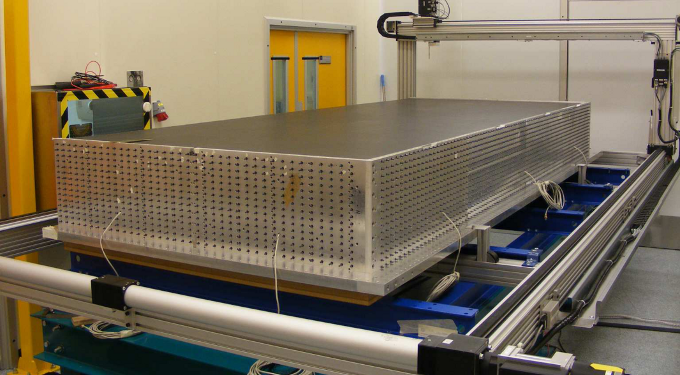
A key element of the T2K near detector is the ND280 electromagnetic calorimeter (ECal), consisting of active scintillator bars sandwiched between lead sheets and read outwith multi-pixel photon counters (MPPCs). The ECal is vital to the reconstruction of neutral particles, and the identification of charged particle species. The ECal surrounds the Pi-0 detector (P0D) and the tracking region of the ND280, and is enclosed in the former UA1/NOMAD dipole magnet. This paper describes the design, construction and assembly of the ECal, as well as the materials from which it is composed. The electronic and data acquisition (DAQ) systems are discussed, and performance of the ECal modules, as deduced from measurements with particle beams, cosmic rays, the calibration system, and T2K data, is described.
Measurement of Neutrino Oscillation Parameters from Muon Neutrino Disappearance with an Off-axis Beam
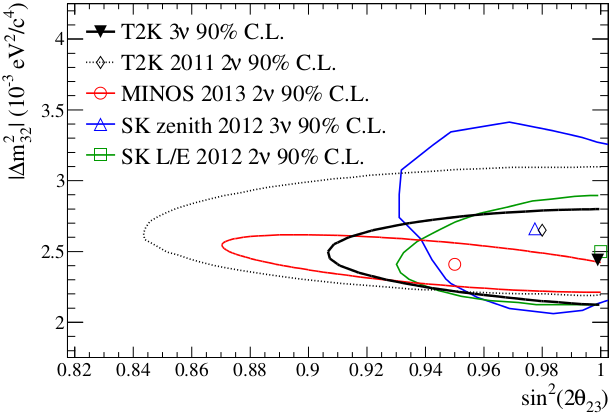
The T2K collaboration reports a precision measurement of muon neutrino disappearance with an off-axis neutrino beam with a peak energy of 0.6 GeV. Near detector measurements are used to constrain the neutrino flux and cross section parameters. The Super-Kamiokande far detector, which is 295 km downstream of the neutrino production target, collected data corresponding to 3.01 × 10²⁰ protons on target. In the absence of neutrino oscillations, 205 ± 17 (syst.) events are expected to be detected and only 58 muon neutrino event candidates are observed. A fit to the neutrino rate and energy spectrum assuming three neutrino flavors, normal mass hierarchy and θ23≤ π/4 yields a best-fit mixing angle sin2(2θ23)=1.000 and mass splitting |Δ m232| =2.44 × 10⁻³ eV2/c4. If θ23≥ π/4 is assumed, the best-fit mixing angle changes to sin2(2θ23)=0.999 and the mass splitting remains unchanged.
Evidence of Electron Neutrino Appearance in a Muon Neutrino Beam
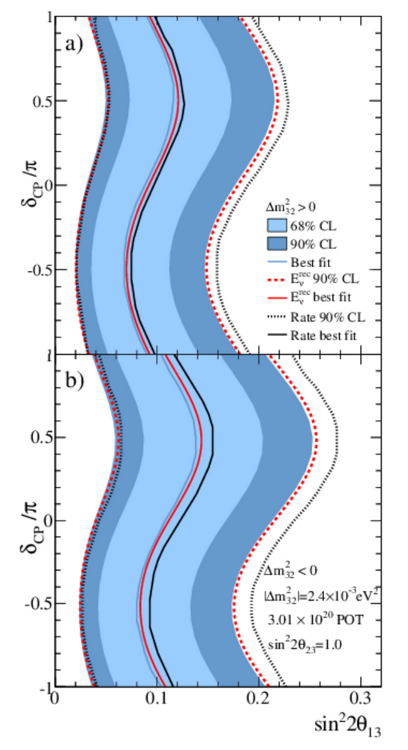
The T2K collaboration reports evidence for electron neutrino appearance at the atmospheric mass splitting, |Δm322|=2.4×10⁻³ eV2. An excess of electron neutrino interactions over background is observed from a muon neutrino beam with a peak energy of 0.6 GeV at the Super-Kamiokande (SK) detector 295 km from the beam’s origin. Signal and background predictions are constrained by data from near detectors located 280 m from the neutrino production target. We observe 11 electron neutrino candidate events at the SK detector when a background of 3.3±0.4(syst.) events is expected. The background-only hypothesis is rejected with a p-value of 0.0009 (3.1σ), and a fit assuming νμ→νe oscillations with sin2(2θ23)=1, δCP=0 and |Δm322|=2.4×10⁻³ eV2 yields sin2(2θ13)=0.088+0.049-0.039(stat.+syst.).
Measurement of the Inclusive NuMu Charged Current Cross Section on Carbon in the Near Detector of the T2K Experiment

T2K has performed the first measurement of νμ inclusive charged current interactions on carbon at neutrino energies of ~1 GeV where the measurement is reported as a flux-averaged double differential cross section in muon momentum and angle. The flux is predicted by the beam Monte Carlo and external data, including the results from the NA61/SHINE experiment. The data used for this measurement were taken in 2010 and 2011, with a total of 10.8 × 10¹⁹ protons-on-target. The analysis is performed on 4485 inclusive charged current interaction candidates selected in the most upstream fine-grained scintillator detector of the near detector.
The flux-averaged total cross section is <σCC>φ =(6.91 +/- 0.13 (stat) +/- 0.84 (syst)) ×10-39 cm2/nucleon for a mean neutrino energy of 0.85 GeV.
The T2K ND280 Off-Axis Pi-Zero Detector
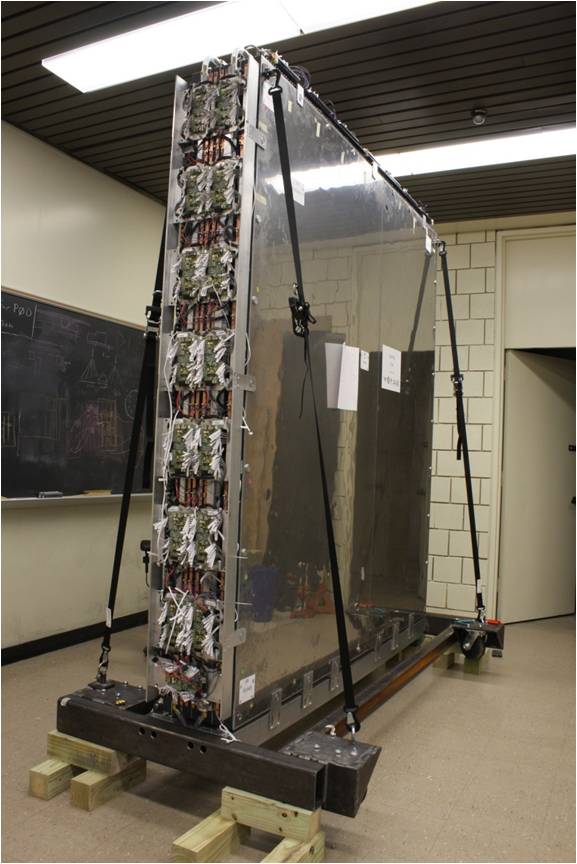
The Pi-Zero detector (PØD) is one of the subdetectors that makes up the off-axis near detector for the Tokai-to-Kamioka (T2K) long baseline neutrino experiment. The primary goal for the PØD is to measure the relevant cross sections for neutrino interactions that generate pi-zero’s, especially the cross section for neutral current pi-zero interactions, which are one of the dominant sources of background to the electron neutrino appearance signal in T2K. The PØD is composed of layers of plastic scintillator alternating with water bags and brass sheets or lead sheets and is one of the first detectors to use Multi-Pixel Photon Counters (MPPCs) on a large scale.