Recommendation by the Panel for the future J-PARC Neutrino program
The Panel for the future J-PARC neutrino program announced the recommendation on the strategy for the future neutrino program at J-PARC. The panel members are chosen from the T2K collaboration, the Hyper-K proto-collaboration and the J-PARC accelerator group.
The full recommendation can be found here.
T2K Run 9 ends with record proton delivery
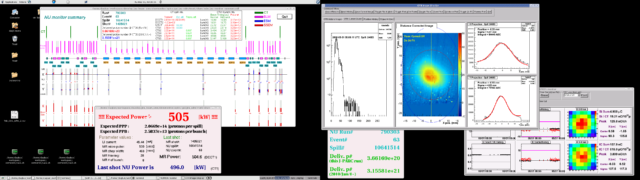
T2K ended its 2017-18 data-taking run on May 31, 2018, with a record power of 500 kW delivered by the J-PARC Main Ring accelerator. T2K has accumulated a total of 3.16×10^21 protons on target (POT) so far. Preliminary results from a subset of these data were presented at the XXVIII International Conference on Neutrino Physics and Astrophysics (Neutrino 2018) in Heidelberg, Germany, on June 4 2018. Scientific results from the full data set will be released in the summer 0f 2018.
The protons are produced by the J-PARC Main Ring synchrotron accelerator in Tokai on the east coast of Japan. The 30 GeV protons are directed onto a graphite target, producing charged pions and other secondary particles. These pions pass through three magnetic “horns,” which are able to preferentially focus either positively-charged or negatively-charged pions in the direction of T2K’s neutrino detectors. Positively charged pions quickly decay to produce muon neutrinos , while negatively charged pions decay to produce muon antineutrinos. This allows T2K to produce a beam composed mostly of muon neutrinos or muon antineutrinos by changing the direction of the magnetic horn current.
J-PARC delivers 3.0e21 protons on target to T2K!
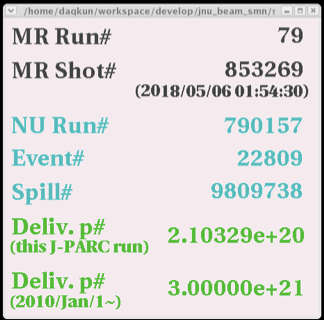
On May 5, 2018, the number of protons delivered to the neutrino target of the T2K experiment by the J-PARC accelerator reached an important milestone: 3×10^21 accumulated since January 2010. Many thanks and congratulations to the J-PARC accelerator teams for their outstanding work to make this possible !
The protons are produced by the J-PARC Main Ring synchrotron accelerator in Tokai on the east coast of Japan. The 30 GeV protons are directed onto a graphite target, producing charged pions and other secondary particles. These pions pass through three magnetic “horns,” which are able to preferentially focus either positively-charged or negatively-charged pions in the direction of T2K’s neutrino detectors. Positively charged pions quickly decay to produce muon neutrinos , while negatively charged pions decay to produce muon antineutrinos. This allows T2K to produce a beam composed mostly of muon neutrinos or muon antineutrinos by changing the direction of the magnetic horn current.
The number of protons delivered by the accelerator to the neutrino generating target is called “Protons on Target (POT)”, which is the typical performance indicator for the data volume of accelerator-based neutrino experiments, like T2K. For discoveries of new physics in the neutrino sector, we are aiming to maximise the accumulation of POT.
T2K is operating stably with an average beam power of about 495 kW in 2018.
T2K and NOvA collaborations to produce joint neutrino oscillation analysis
The NOvA and T2K Collaborations are working towards the formation of a joint working group to enhance the measurements of neutrino oscillation parameters made by each Collaboration individually. The projected timescale of the NOvA-T2K working group is for production of a full joint neutrino oscillation analysis by 2021.
Prof Chang Kee Jung named AAAS Fellow
 Prof Chang Kee Jung, of Stonybrook University, has been named a fellow of the AAAS (American Association for the Advancement of Science) for “his leadership role in neutrino research, particularly for establishing evidence for electron-neutrino appearance from a muon neutrino beam.” Prof Jung served as International Co-Spokesperson of the T2K Collaboration 2011–2015.
The T2K Collaboration currently includes over 400 members from 65 institutions in 12 countries.
T2K is hosted jointly by the High Energy Accelerator Research Organization (KEK) and the Institute for Cosmic Ray Research, University of Tokyo (ICRR).
The T2K Collaboration congratulates Prof Jung!
T2K presents hint of CP violation by neutrinos
The international T2K Collaboration strengthened its previous hint that the symmetry between matter and antimatter may be violated for neutrino oscillation. A preliminary analysis of T2K’s latest data rejects the hypothesis that neutrinos and antineutrinos oscillate with the same probability at 95% confidence (2σ) level. With nearly twice the neutrino data in 2017 compared to their 2016 results, T2K has performed a new analysis of neutrino and antineutrino data using a new event reconstruction algorithm for interactions in the far detector, Super-Kamiokande. Today’s announcement was made by Prof Mark Hartz, of the University of Tokyo Kavli Institute for the Physics and Mathematics of the Universe (Japan) and TRIUMF (Canada), who presented the results at a colloquium at the High Energy Accelerator Research Organization (KEK) in Tsukuba, Japan.
Why the universe is primarily comprised of matter today, instead of being comprised of equal parts matter and antimatter, is one of the most intriguing questions in all of science. One of the conditions required for the observed dominance of matter over antimatter to develop is the violation of Charge-Parity (CP) symmetry, which is the principle that the laws of physics should be the same if viewed upside-down in a mirror (Parity), with all matter exchanged with antimatter (Charge). If CP violation occurs in neutrinos, it will manifest itself as a difference in the oscillation probabilities of neutrinos and antineutrinos.
Whether the probability for electron neutrino appearance exceeds, or not, the electron antineutrino appearance probability depends on the value of the CP violating phase, δCP, introduced by Kobayashi and Maskawa. The CP violating phase can take any value from –180° to +180°, and if it deviates from 0° and ±180° then CP violation occurs. It has been measured to be around 68° for quarks; T2K’s goal is to measure the neutrino CP phase for the first time.
In the T2K experiment in Japan, a muon neutrino beam is produced at the Japan Proton Accelerator Research Complex (J-PARC) located in Tokai village, Ibaraki prefecture, on the east coast of Japan. The neutrino beam is created by directing 30 GeV protons from the J-PARC Main Ring (MR) accelerator onto a cylindrical target to produce an intense secondary particle beam that is focused and filtered by strong magnetic lenses called neutrino horns. The focused particle beam decays into a beam of muon neutrinos or antineutrinos, depending on the filtering done by the neutrino horns. The neutrino/antineutrino beam is monitored by a detector complex in Tokai, 280 m away from the neutrino target, and is aimed at the gigantic Super-Kamiokande underground detector in Kamioka, near the west coast of Japan, 295 kilometers (185 miles) away from Tokai. During their journey, a small fraction of these muon neutrinos will turn into electron neutrinos.
T2K’s observed electron neutrino appearance rate is significantly higher than would be expected if CP symmetry were conserved. In contrast, the antineutrino data set, while still too small to make strong statements, shows a smaller electron antineutrino appearance rate than would be expected if CP symmetry were conserved. T2K observes 89 electron neutrinos while approximately 67 neutrinos are expected with no CP violation, and they observe 7 electron antineutrinos when approximately 9 are expected. When analyzed in a full framework of three neutrino and antineutrino flavors, and combined with measurements of electron antineutrino disappearance from reactor experiments, the T2K data exclude CP conservation at the 95% confidence (2σ) level. The 95% CL allowed region for the CP violating phase, δCP, is [–171°; –34°] ([–88°; –68°]) for the normal (inverted) hierarchy, with the best fit point being –105° (–79°). The size of the expected T2K allowed region for this data set, using the constraint from the reactor experiments, is a 95% CL region spanning approximately [–200°; +12°] ([–156°; –22°]) for the normal (inverted) hierarchy, assuming a case of maximal CP violation.
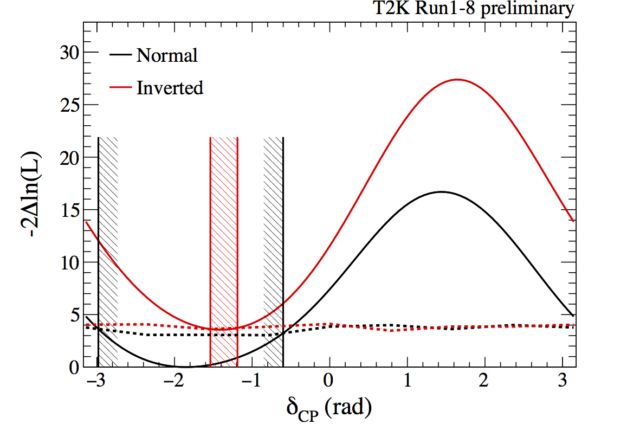 −2∆lnL (equivalent of Δχ2) as a function of δCP for the normal (black) and inverted (red) mass ordering. The vertical lines show the corresponding allowed 95% confidence interval, calculated using the Feldman-Cousins method.
This new data analysis includes use of an improved event reconstruction algorithm for neutrino and antineutrino interactions in Super-Kamiokande. With this new event reconstruction algorithm, the signal to background ratio of events used in the analysis is improved and the systematic errors associated with event reconstruction are reduced. Moreover, the new reconstruction algorithm allows the volume of the detector to be used more effectively for collecting neutrino interactions. This new CP violation result also includes the use of an additional selected sample of electron neutrino events at Super-Kamiokande. Taken together, the new reconstruction algorithm and the additional data sample amount to a data selection efficiency increase of 30%.
The T2K experiment is primarily supported by the Japanese Ministry for Culture, Sports, Science, and Technology (MEXT), and is jointly hosted by the High Energy Accelerator Research Organization (KEK) and the University of Tokyo’s Institute for Cosmic Ray Research (ICRR). The T2K experiment was constructed and is operated by an international collaboration, which currently consists of nearly 500 scientists from 63 institutions in 11 countries [Canada, France, Germany, Italy, Japan, Poland, Russia, Spain, Switzerland, UK, and USA]. This observation is made possible by the efforts of J-PARC to deliver high-quality beam to T2K.
This 2017 result is based on a total data set of 2.25×10²¹ protons on target (POT), which is 28% of the POT exposure that T2K is set to receive. If there were no neutrino-antineutrino asymmetry, the chance of observing an asymmetry as large as what T2K observed, due to random statistical fluctuations, is about 1 in 20. To explore and solidify this intriguing hint the T2K collaboration need more neutrino and antineutrino data. The full T2K exposure of 7.8×10²¹ POT is expected to come by ~2021, thanks to planned upgrades to the J-PARC MR accelerator and the neutrino beamline. Moreover, T2K has proposed a run extension that will lead to a full exposure of 20×1021 POT, with 3σ sensitivity to CP violation observation (for certain values of oscillation parameters, including the current best-fit point) by ~2026. An upgrade of the T2K near detector for the run extension is currently being designed, with a planned installation date of 2021. The T2K run extension has been given stage-1 status by the J-PARC Centre Directorate. The T2K run extension will be completed around 2026, when the next generation experiment Hyper-Kamiokande is expected to come online; Hyper-Kamiokande has been included in the MEXT roadmap for Large Projects.
The search for CP symmetry violation with neutrinos and antineutrinos builds on T2K’s 2013 discovery of electron neutrino appearance in a muon neutrino beam, which was the first statistically significant observation of the appearance of a neutrino flavour. This appearance is an example of neutrino oscillation, a purely quantum mechanical long-range interference phenomenon; neutrino oscillation proves conclusively that neutrinos have non-zero mass. T2K’s 2013 electron neutrino appearance discovery resulted in a share of the 2016 Breakthrough Prize for Fundamental Physics being awarded to Koichiro Nishikawa and the entire T2K collaboration.
More details on the new T2K result, as well as prospects for future running of the experiment, can be found in the presentation file from the KEK seminar, and more information about the T2K experiment can be found elsewhere on this T2K public website.
Media Contacts for Further Inquiries:
- Globally and in Japan:
- Prof. Tsuyoshi Nakaya, Spokesperson, T2K Collaboration, Kyoto University (Kyoto, Japan), t.nakaya@scphys.kyoto-u.ac.jp, Phone: +81-75-753-3870
- Globally and in U.K.:
- Dr. Morgan Wascko, International Co-Spokesperson, T2K Collaboration, Imperial College London, m.wascko@imperial.ac.uk, Phone: +44-207-594-3465, +44-7939-592-708
- In Canada:
- Prof. Hirohisa Tanaka, University of Toronto (Toronto, Canada), htanaka@physics.utoronto.ca, Phone: +1-647-549-3690
- In France:
- Dr. Marco Zito, CEA/IRFU (Saclay, France), marco.zito@cea.fr, Phone: +33 6 84 61 09 51
- Dr Jacques Dumarchez, IN2P3/CNRS (Paris, France), jacques.dumarchez@cern.ch, Phone: +33 1 44 27 48 42
- In Germany:
- Dr. Stefan Roth, RWTH Aachen University (Aachen, Germany), roth@physik.rwth-aachen.de, Phone: +49 241 80 27296
- In Italy:
- Dr. Maria Gabriella Catanesi, INFN Sezione di Bari (Bari, Italy), gabriella.catanesi@cern.ch, Phone: +41 764871532
- In Poland:
- Prof. Ewa Rondio, NCBJ, Warsaw (Warsaw, Poland), Ewa.Rondio@fuw.edu.pl, Phone: +48 691 150 052
- In Russia:
- Prof. Yuri Kudenko, INR (Moscow, Russia), kudenko@inr.ru, Phone: +7-903-6159125 (c), +7-495-8504248 (o)
- In Spain:
- Prof. Federico Sanchez, IFAE, Barcelona (Barcelona, Spain), fsanchez@ifae.es, Phone: +34 93 5812835
- Prof. Anselmo Cervera, IFIC, Valencia (Valencia, Spain), anselmo.cervera@cern.ch
- In Switzerland:
- Prof. Alain Blondel, Université de Genève, alain.blondel@unige.ch, Phone: +41 22 379 6227
- In U.K.:
- Prof. Dave Wark, STFC/RAL/Daresbury Laboratory/Oxford University (Oxford, U.K.), david.wark@stfc.ac.uk, Phone: +44 7788186085
- In U.S.A.:
- Prof. Chang Kee Jung, State University of New York at Stony Brook (Stony Brook, NY, USA), chang.jung@stonybrook.edu, Phone: +1 631-707-2018
- About KEK:
- Hajime Hikino, PR office, High Energy Accelerator Organization (KEK, Japan), press@kek.jp, Phone: +81-29-879-6046
- About ICRR:
- Hironori Fukuda, the University of Tokyo’s Institute for Cosmic Ray Research (ICRR, Japan), hfukuda@icrr.u-tokyo.ac.jp, Phone: +81-4-7136-5148
- About J-PARC:
- Saeko Okada, PR section, J-PARC, pr-section@j-parc.jp, Phone: +81-29-284-4578
T2K beam run extension given Stage-1 Status at J-PARC
On 30 Sep, 2016, the KEK-IPNS Director and J-PARC Center Director granted stage-1 status to the T2K collaboration’s proposal for an extended beam data run to search for CP violation by neutrinos. The proposal requests delivery of 20×10²¹ protons-on-target (POT) by 2026, which would allow the possibility of 3 sigma sensitivity for CP violation. In order to achieve this, accelerator upgrades are being planned, as well as upgrades to the neutrino beam line and near detectors. The original T2K run plan is for delivery of 7.8×10²¹ POT.
First T2K CP violation search published
T2K’s first search for violation of charge-parity symmetry (CP violation) was published in Physical Review Letters as an Editors Suggestion in the April 14 edition. This is the first result from T2K that simultaneously analyses both neutrino and antineutrino data sets.
The international T2K (Tokai-to-Kamioka) collaboration searches for CP violation with both neutrino and antineutrino beams, and is the world’s first experiment to publish an exclusion of CP conservation at 90% CL. The experiment, hosted by KEK (High Energy Accelerator Research Organization) and ICRR (Institute for Cosmic Ray Research), consists of high intensity beams of muon neutrinos (or muon antineutrinos) that are produced at J-PARC (Japan Proton Accelerator Research Complex) on Japan’s east coast, and fired towards the Super-Kamiokande detector 295 km away in Gifu Prefecture. On the way, the neutrinos and antineutrinos spontaneously change ‘flavor’, with muon neutrinos changing to electron neutrinos and muon antineutrinos changing to electron antineutrinos. A difference in the rates of oscillations in separate neutrino and antineutrino beams would be the signature of an imbalance between particles and antiparticles, which would be expected to reveal new phenomena beyond the Standard Model of particle physics.
The first CP violation study by T2K was published in April, and detected 32 electron neutrinos and 4 electron antineutrinos, to be compared to expectations of 24 neutrinos and 7 antineutrinos if there were no CP violation. Recently, thanks to outstanding beam delivery by the J-PARC facility, the T2K experiment has finished collecting data in neutrino mode that has doubled the amount of neutrino data available, and its results are expected to be presented later this year.
“The 2016 CP violation search was a successful first look at both neutrinos and antineutrinos. We look forward to presenting results from our new data set in the summer of 2017,” said T2K Spokesperson Prof Tsuyoshi Nakaya (Kyoto University).
T2K will continue to run for another 10 years, and is currently planning upgrades to both the neutrino beam and the neutrino detectors.
J-PARC delivers 2.0e21 protons on target
On March 2, the number of protons delivered to the neutrino target of the T2K experiment by the J-PARC accelerator reached an important milestone: 2×10^21 accumulated since January 2010. Many thanks are due to the J-PARC directorate and the staff members for their outstanding work to make this possible !
The protons are produced by the J-PARC Main Ring synchrotron accelerator in Tokai on the east coast of Japan. The 30 GeV protons are directed onto a graphite target, producing charged pions and other secondary particles. These pions pass through three magnetic “horns,” which are able to preferentially focus either positively-charged or negatively-charged pions in the direction of T2K’s neutrino detectors. Positively charged pions quickly decay to produce muon neutrinos , while negatively charged pions decay to produce muon antineutrinos. This allows T2K to produce a beam composed mostly of muon neutrinos or muon antineutrinos by changing the direction of the magnetic horn current.
The number of protons delivered by the accelerator to the neutrino generating target is called “Protons on Target (POT)”, which is the typical performance indicator for the data volume of accelerator-based neutrino experiments, like T2K. For discoveries of new physics in the neutrino sector, we are aiming to maximise the accumulation of POT.
T2K is currently operating stably with an average beam power of about 470 kW.
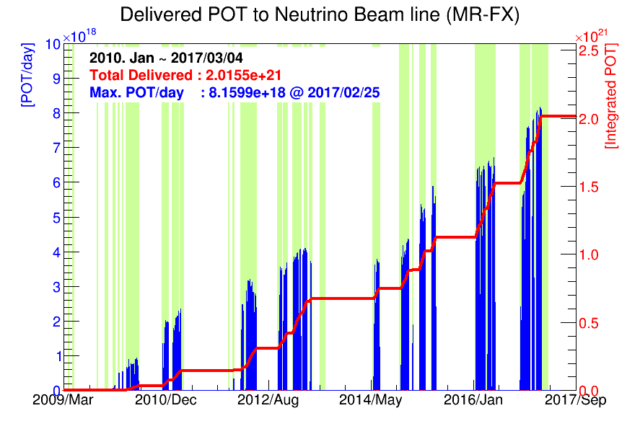
Accumulation of protons on target (POT) delivered to the neutrino beam line from January 2010 to March 4th, 2017. Blue line shows POT per day, red line shows cumulative value.
Koichiro Nishikawa wins 2016 Pontecorvo Prize
Professor Koichiro Nishikawa has been awarded the Bruno Pontecorvo Prize for the year 2016. The Bruno Pontecorvo Prize is awarded by the Joint Institute for Nuclear Research (JINR) in Dubna, Russia, for elementary particle physics. The prize commemorates Prof. Bruno Pontecorvo, a pioneering neutrino physicist who worked for many decades at JINR.
The Prize was awarded to Prof Nishikawa «for his outstanding contributions to the study of the neutrino oscillation phenomenon and to the measurement of the θ13 mixing angle in the T2K experiment». Prof Nishikawa is the founding spokesperson of the T2K and K2K collaborations. The Prize is shared by Prof Nishikawa with Prof Yifang Wang (IHEP, China) for the Daya Bay experiment and Prof Soo-Bong Kim (SNU, Republic of Korea) for the RENO experiment.
The 2016 Pontecorvo Prize decision was approved by the JINR Scientific Council on 24 February 2017, and Prof Nishikawa will be invited to an awards ceremony at the September 2017 session of the JINR Scientific Council to receive the award.
T2K is an accelerator-based long-baseline neutrino experiment in Japan. It uses the J-PARC Main Ring proton accelerator to create an intense beam of muon neutrinos. The neutrinos are directed to the Super-Kamiokande detector in the Kamioka mine deep inside Mt Ikeno, 295 km away from J-PARC. Prof Nishikawa’s citation for the prize was given for the observation of electron neutrino appearance in the muon neutrino beam, which is the first observation of the appearance of a neutrino flavour. This discovery sets the stage for the study of differences in the neutrino oscillation process relative to their antiparticles (antineutrinos), called CP violation, that may elucidate how the universe came to be matter dominated. T2K has recently published the first search for CP violation with neutrino and antineutrino oscillations.
The T2K Collaboration currently includes over 400 members from 64 institutions in 12 countries.
T2K is hosted jointly by the High Energy Accelerator Research Organization (KEK) and the Institute for Cosmic Ray Research, University of Tokyo (ICRR).